
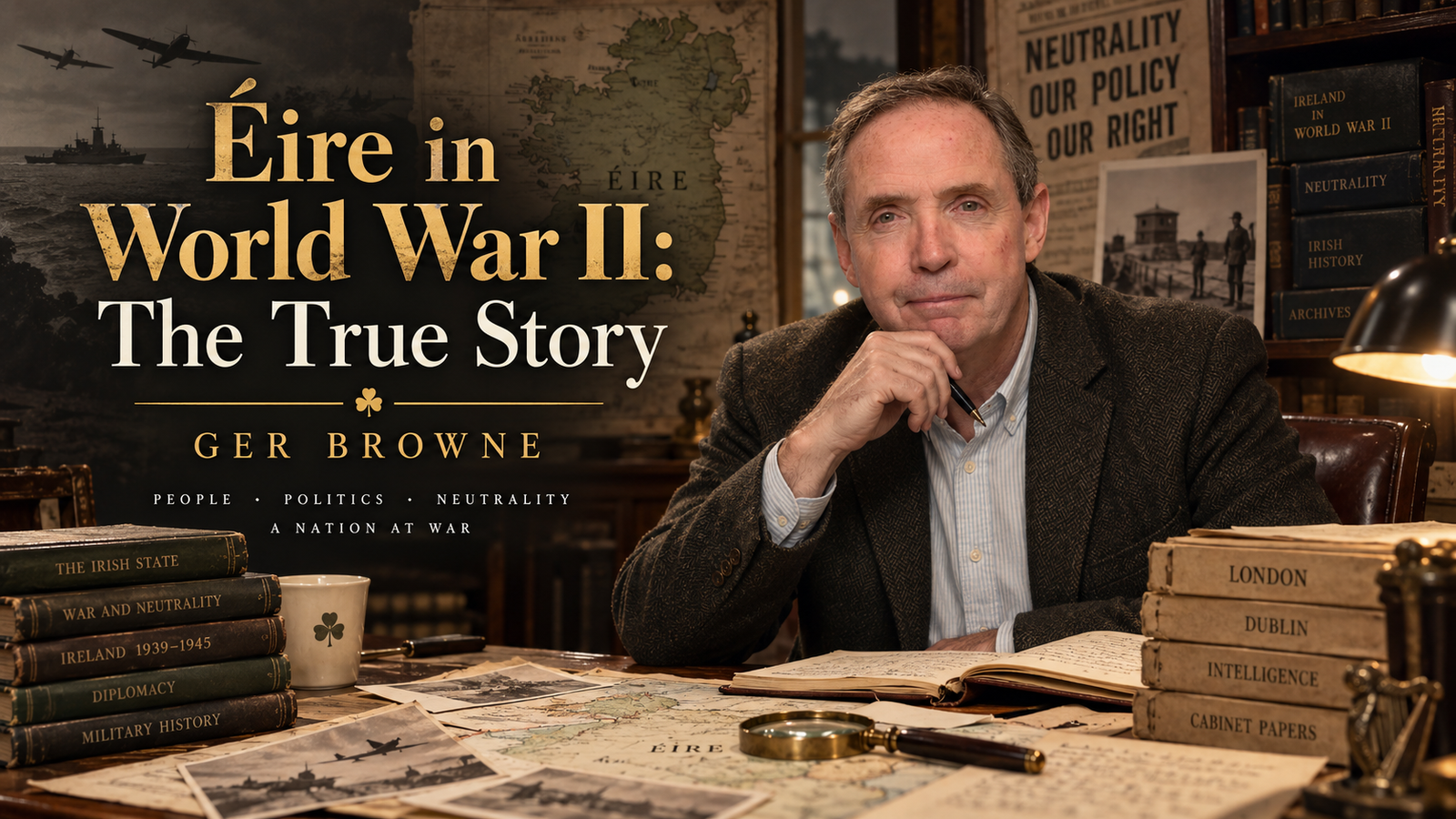
For decades, Ireland’s role in the Second World War has often been summarized in a single word: neutrality.
But the reality was far more complicated.
In Éire in World War II: The True Story, author and historical researcher Ger Browne, together with a group of contributors, examines the evidence behind Ireland’s wartime position and reveals a story of intelligence cooperation, military preparation, Allied assistance, personal sacrifice, and thousands of Irish lives shaped by the conflict.
Published through Kingsford Publishing, the book draws on declassified records, military archives, diplomatic documents, historical research, and individual wartime accounts to reconsider one of the most debated periods in modern Irish history.
Looking Beyond the Traditional Story of Irish Neutrality
During the Second World War, Ireland maintained an official policy of neutrality, and the period became known domestically as “The Emergency.”
That political position has often led to the assumption that Ireland remained largely separate from the Allied war effort.
Éire in World War II: The True Story challenges that simplified view.
The research presented in the book examines the many ways in which Ireland quietly supported Allied interests while maintaining its official neutral status. These included intelligence sharing, weather reporting, cooperation between military authorities, assistance to Allied personnel, and the movement of Irish volunteers and workers into Britain’s wartime effort.
The book also addresses long-standing claims surrounding German U-boats, Irish attitudes toward Nazi Germany, the treatment of returning veterans, and other myths that have continued to shape public discussion of Ireland during the war.
Ireland’s Quiet Contribution to the Allied War Effort
One of the central arguments explored throughout the book is that Ireland’s neutrality did not mean complete isolation from the conflict.
Historical records examined by the contributors show extensive cooperation with Britain and the Allies.
Among the subjects explored are the Donegal Corridor, which allowed Allied aircraft to cross Irish territory; intelligence cooperation between Irish military intelligence and British security services; the transmission of weather data; the treatment of Allied aircrews; and the strategic importance of locations such as Foynes and Shannon.
Irish weather information also played an important role in Allied forecasting. The manuscript discusses the weather reports from Blacksod in County Mayo that contributed to the forecasting surrounding the D-Day landings in June 1944.
These examples help reveal a wartime relationship that was considerably more complex than the word “neutral” alone suggests.
Fort Shannon and Anglo-Irish Wartime Cooperation
A particularly fascinating part of this history is Fort Shannon, the coastal defence installation overlooking the Shannon Estuary.
The book explores the strategic importance of Foynes during the war and the defensive measures established around the Shannon Estuary. Fort Shannon became an important example of the practical cooperation that existed between Ireland and Britain despite Ireland’s formal neutrality.
The subject has also been examined in the important study Fort Shannon: A Case History in Anglo-Irish Cooperation during the Second World War by Donard de Cogan and S. Swords.
For readers interested in military history, coastal defence, and the realities of Anglo-Irish wartime cooperation, Fort Shannon provides an especially revealing case study.
Remembering the Irish Men and Women Who Served
The book is not only about governments, diplomacy, and military strategy.
At its heart is a large human record.
One of the most substantial sections documents 5,411 men and women from Éire who died during the Second World War. Their stories include members of the British Armed Forces, Merchant Navy personnel, civilians, medical staff, and others whose lives were lost across different theatres of war.
Individual entries record names, places of birth, service details, circumstances of death, and burial or memorial locations.
By documenting these lives individually, the book moves beyond statistics and restores names and personal histories to a part of the Irish wartime story that has often received less attention.
Irish Volunteers During World War II
Thousands of Irish men and women also left Ireland to participate directly in the Allied war effort.
The manuscript discusses research estimating substantial Irish enlistment in British forces, alongside large numbers who travelled to Britain to work in wartime industries, agriculture, transport, emergency services, and other essential roles.
Their motivations varied.
Some joined because they wanted to fight fascism. Others sought adventure, employment, or a sense of duty. Whatever their individual reasons, their participation demonstrates that Ireland’s wartime experience cannot be understood through government policy alone.
A Book Built on Historical Evidence
A major strength of Éire in World War II: The True Story is its reliance on documentary evidence.
The work draws from Irish and British archives, declassified intelligence records, military documents, wartime correspondence, casualty records, and previous historical scholarship.
This approach allows the contributors to revisit claims that were difficult to properly assess while key wartime files remained classified.
The book brings together contributions from Ger Browne, Jim O’Neill, John Crotty, Donard de Cogan, and Eddie Lough, with an introduction by Major General (Retired) Adrian Ó Murchú.
Together, their work examines the political, military, intelligence, and human dimensions of Ireland’s wartime experience.
Why This Story Still Matters
History is often remembered through simplified narratives.
Ireland was neutral. Britain fought Germany. The Allies won.
All of those statements may be broadly true, but they do not tell the entire story.
The historical evidence explored in Éire in World War II: The True Story reveals a more complicated reality: a neutral state quietly cooperating with the Allies, intelligence officers sharing information, Irish volunteers serving abroad, workers contributing to wartime industries, and thousands of families experiencing the consequences of a global conflict.
Understanding those details matters because they change how we interpret Ireland’s relationship with Britain, the meaning of neutrality, and the contribution made by Irish people during the Second World War.
Discover More About Ger Browne and His Historical Research
Ger Browne’s work extends beyond this book.
His historical research includes extensive material relating to Éire during World War II, County Clare, the First World War, the Irish revolutionary period, and local history.
Readers who would like to explore more of his research, featured articles, historical material, and information about Éire in World War II: The True Story can visit:
Ger Browne’s Official Website:
https://gerbrowne.com/
You can also explore Ger Browne’s ongoing historical commentary and thousands of posts relating to Éire and the Second World War on X at @GerBrowne4.
About the Book
Title: Éire in World War II: The True Story
Author: Ger Browne
Contributors: Jim O’Neill, John Crotty, Donard de Cogan, Eddie Lough
Introduction: Major General (Retired) Adrian Ó Murchú
Publisher: Kingsford Publishing
Available Formats: Paperback, Hardcover, and eBook.
For readers of Irish history, World War II history, military history, Anglo-Irish relations, intelligence history, and wartime biography, Éire in World War II: The True Story offers a substantial documentary account of a story that deserves closer examination.
Learn more about Ger Browne’s research on Éire and World War II on his official website.